
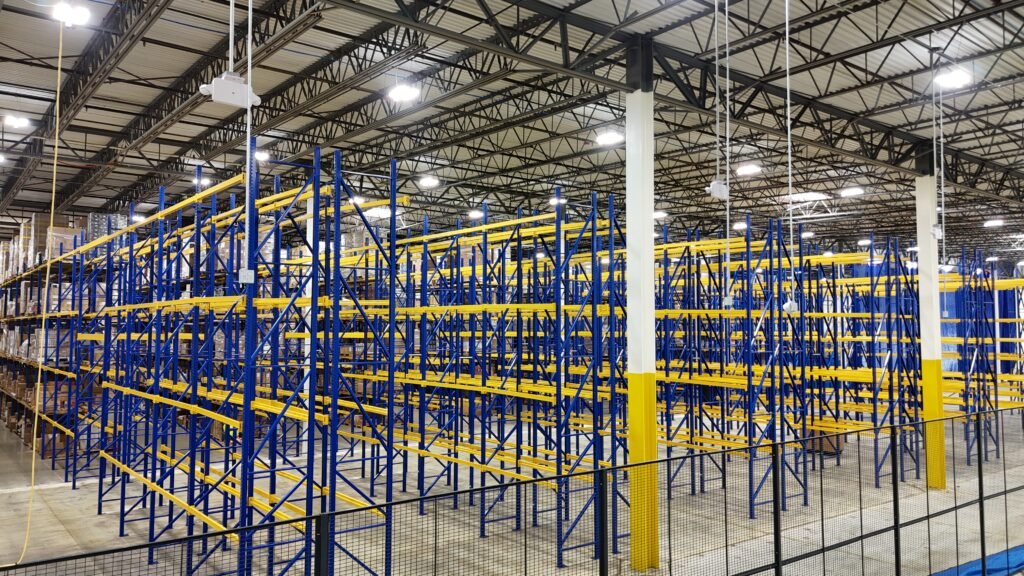
As businesses grow and product lines expand, warehouse managers often face a common and costly challenge—not enough storage space. But before you start looking into expensive facility expansions or offsite warehousing, there’s good news: your existing warehouse likely has untapped storage potential.
At Matco Material Handling, we specialize in warehouse optimization strategies that turn wasted vertical space, inefficient layouts, and outdated storage systems into high-density, high-efficiency storage solutions. Whether you operate a distribution center, manufacturing plant, or e-commerce fulfillment center, this guide will walk you through how to increase warehouse storage capacity using smart, scalable solutions.
1. Upgrade to High-Density Pallet Racking Systems
One of the quickest ways to increase storage capacity is by upgrading your pallet racking. Traditional selective racking may be convenient, but it doesn’t always make the best use of vertical or horizontal space.
Consider switching to:
Drive-in or drive-through racking for high-volume, low-SKU operations.
Push-back racking for last-in, first-out (LIFO) inventory strategies.
Pallet flow racking for first-in, first-out (FIFO) inventory rotation.
Double-deep racking for added pallet positions without expanding your footprint.
These high-density pallet racking systems allow you to store more pallets per square foot—increasing warehouse storage capacity dramatically without requiring more real estate.
2. Maximize Vertical Storage with Taller Uprights
If your warehouse has high ceilings, make them work for you. 18′ to 24′ pallet rack uprights can significantly increase cubic storage volume, especially when combined with narrow aisle configurations and reach trucks or order pickers.
A vertical expansion is often the most cost-effective way to grow your capacity, and it’s a strategy we regularly implement using custom rack configurations and AutoCAD warehouse layout services.
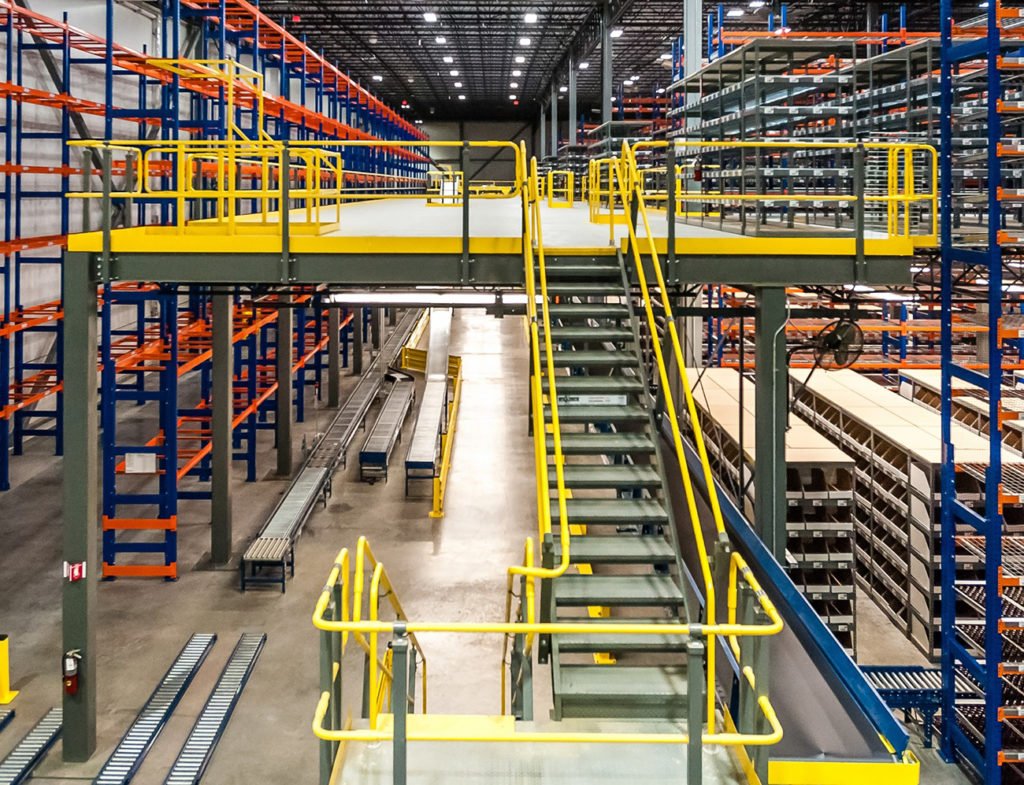
3. Install a Mezzanine Floor
A warehouse mezzanine system essentially gives you a second floor without construction costs. Use it for:
Additional racking
Packing stations
Office space
Inventory overflow
Mezzanines are modular, customizable, and a smart option for increasing square footage within your existing facility.
4. Reevaluate Your Aisle Widths
Standard aisles are often 12 feet wide, but switching to narrow aisle (NA) or very narrow aisle (VNA) systems can increase pallet positions by up to 40%. If your equipment allows for it, tighter aisles create room for more racking without compromising access or safety.
5. Use Carton Flow and Shelving Systems for Small Items
Not everything belongs on a pallet. If you store small parts, cases, or individual products, carton flow racks, modular shelving, and bin systems can help you store more SKUs in less space.
Gravity-fed shelves improve pick rates and reduce replenishment time.
Tilted bins and adjustable shelving make better use of vertical space.
This is a great solution for e-commerce warehouses or pick-and-pack operations.
6. Implement Smart Warehouse Layout Design
Before spending on equipment, evaluate your warehouse layout. Poorly designed traffic flow, dead-end aisles, or unused corners are often to blame for space shortages.
At Matco, we offer full-service warehouse design, including:
On-site consultations
AutoCAD layout drawings
Multiple layout options to fit your SKU count and product flow
A well-planned layout is foundational to warehouse space optimization.
7. Adopt Vertical Lift Modules and Automated Storage
AS/RS (Automated Storage and Retrieval Systems) and vertical lift modules are ideal for businesses with high SKU counts or space restrictions. They:
Use vertical space more effectively than traditional shelving.
Increase storage density.
Reduce pick times with automation.
While this option has a higher upfront cost, the ROI in labor savings and space efficiency is substantial.
8. Use Cantilever Racking for Long or Irregular Items
If your inventory includes pipe, lumber, furniture, or similar long goods, cantilever racks are the best way to store them. They eliminate wasted space and allow for easy accessibility and safer storage.
9. Create Designated Zones for Each Inventory Type
Don’t mix fast-moving and slow-moving SKUs. Assign storage zones by turnover rate, size, or storage method to:
Improve pick speed
Reduce bottlenecks
Free up prime space for high-volume items
Proper zoning also supports lean warehouse principles, which help in managing inventory more efficiently.
10. Schedule Regular Inventory Audits and Slotting Reviews
Sometimes the issue isn’t space—it’s how inventory is slotted. Regular audits can uncover:
Overstocked SKUs
Obsolete inventory
Items stored inefficiently
By cleaning up your inventory strategy, you can reclaim valuable space and improve order fulfillment.
Final Thoughts: Increasing Warehouse Storage Capacity Without Expansion
Increasing warehouse storage capacity doesn’t always mean a bigger building or a major investment. With the right mix of:
Pallet racking upgrades
Warehouse layout redesign
Vertical utilization
High-density shelving
Custom material handling equipment
You can dramatically improve your space utilization, workflow, and profitability.
At Matco Material Handling, we specialize in designing, supplying, and installing solutions that fit your space and goals—whether you’re a local operation or a national distribution center.
If you’re ready to simplify your inventory handling, reduce safety risks, and improve efficiency, Matco’s ladder cart with locking steps is the solution. To request a quote or learn more, visit www.matcodist.com, call (414) 445-4066, or email [email protected].


